
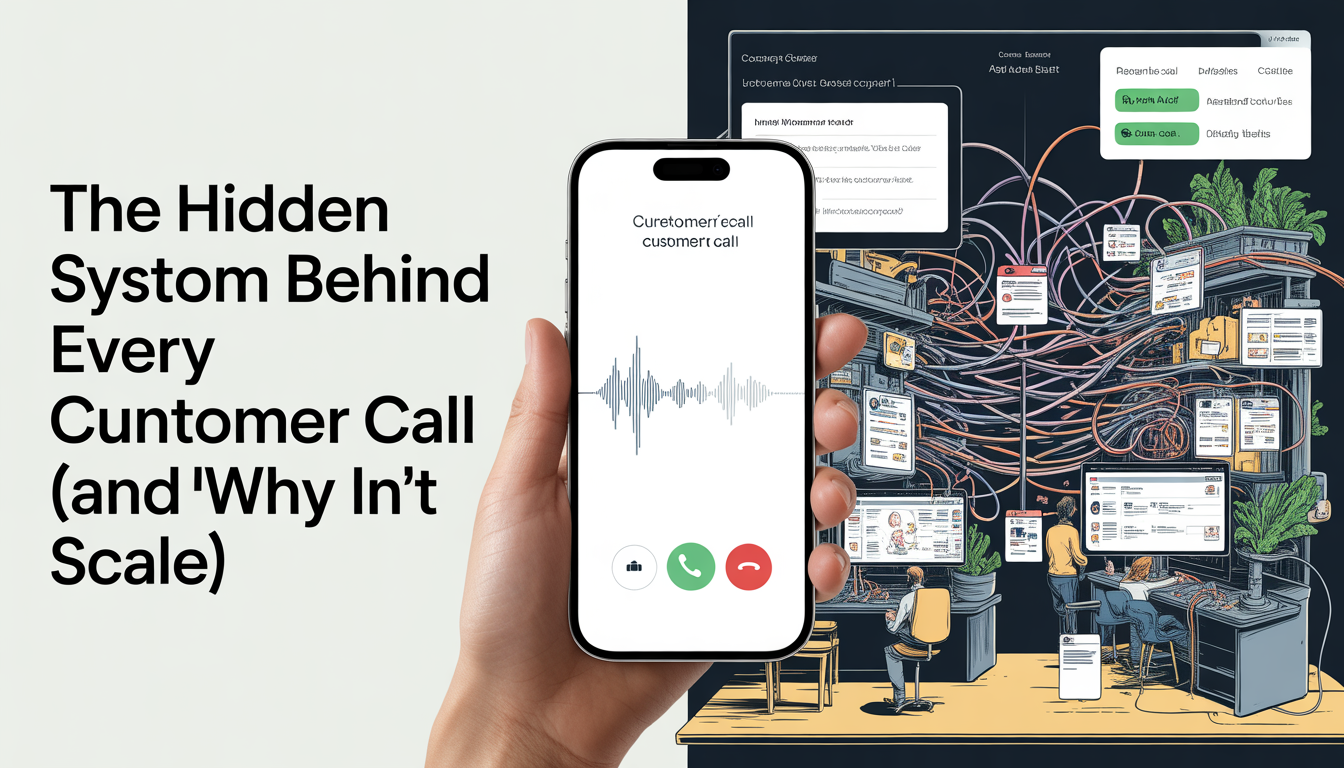

The Hidden System Behind Every Customer Call (And Why It Doesn’t Scale)
It looks like a conversation but it’s actually a process
A customer calls your store:
“Hey, where’s my order?”
Simple question.
Your team answers, checks the order, gives an update, and moves on.
From the outside, it feels like a conversation.
But internally, that call triggered a full workflow:
This is exactly why more brands are turning to AI customer support tools for Shopify to manage what’s happening behind the scenes.
- Identify the customer
- Access Shopify
- Locate the order
- Check fulfillment status
- Interpret tracking
- Communicate the answer
That’s not just support.
That’s a repeatable system being executed manually every single time.
What Most Shopify Brands Don’t See
Every call runs through the same invisible workflow
The problem isn’t the question.
It’s what happens behind it.
Most inbound calls fall into a few predictable categories:
- Order status (“Where is my order?”)
- Address changes
- Delivery issues
- Product questions
Different customers, different wording but the same backend process.
This is where a modern AI Voice Agent becomes relevant—not for answering questions, but for executing workflows.
And here’s the key:
You’re running the same workflow hundreds of times a day using human time.

10 Signals Your Current System Isn’t Built to Scale
- How to handle repetitive customer calls without repeating the same internal steps every time
- Why your team spends most of their time executing processes not solving problems
- The secret to resolving “Where is my order?” calls instantly, without manual lookup
- How to eliminate delays caused by switching between systems during calls
- What most brands miss about how much time each “simple” call actually consumes
- The simple way to respond to customers instantly even when your team is offline
- Why high call volume exposes inefficiencies faster than any other support channel
- How to reduce dependency on agents for predictable, rule-based requests
- The secret to connecting customer conversations directly with order data in real time
- How to scale support without increasing headcount every time order volume grows
This is exactly where Shopify customer support automation starts replacing repetitive execution with structured systems.
Why This System Breaks Under Pressure
At low volume, this works.
You have:
- A manageable number of calls
- Enough agents to handle them
- Time to process each request manually
But as your store grows, the same system starts showing cracks.
What changes as volume increases:
- Calls start queuing
- Agents spend more time on repetitive tasks
- Customers wait longer or drop off
- Internal tools slow down the process
And the biggest issue?
Nothing about the system actually improves. It just gets busier.
The Real Problem: Manual Execution of Structured Work
Every call follows a structure.
But your system treats it like a unique event.
That’s where inefficiency builds.
Your team is:
- Executing the same steps repeatedly
- Switching between tools constantly
- Handling predictable workflows manually
This creates a bottleneck that grows with your business.
Because humans don’t scale efficiently in high-repetition environments.

This is why understanding Shopify support ROI and benchmarks becomes important because the cost of repetition compounds quickly.
What Changes When You Rethink the System
The shift isn’t about answering calls faster.
It’s about asking a different question:
“Does this workflow need a human at all?”
Once you look at support this way, patterns become obvious:
- Most calls don’t require judgment
- Most actions follow defined rules
- Most outcomes are predictable
Which means they can be handled at the system level.
This is exactly what solutions like NextPhone try to address at a surface level—but the real shift happens deeper, at the workflow level.
Where Consio Fits
Consio AI is built to operate inside this hidden system.Explore Consio AI products
Not as another support tool but as a AI voice automation based execution layer.
- It answers inbound calls instantly, 24/7
- It understands customer intent and handles common queries
- It retrieves order data directly from Shopify
- It resolves repetitive workflows automatically
- It sends follow-ups via SMS when needed
- It routes complex cases to your team with full context
All of this is part of a broader AI customer support tools for Shopify ecosystem.
This changes how your system behaves:
- Repetition → automated
- Exceptions → handled by humans
Your team stops executing workflows and starts handling real problems.
Ecommerce growth is not only about getting more shoppers to checkout. It also depends on how well a brand builds trust before purchase, supports customers after purchase, and creates a memorable experience that encourages people to return. Ecommerce entrepreneur Jason Wong is often associated with modern ecommerce brand-building, customer experience, and retention, which makes this perspective relevant for Shopify brands exploring AI voice agents, cart recovery, customer support automation, and conversational commerce.

Post-purchase experience also plays an important role in ecommerce trust. Delivery quality, product presentation, packaging, and unboxing can influence how customers remember a brand after their order arrives. Many ecommerce stores use Custom Packaging to improve product presentation, protect items during delivery, and support a stronger customer experience after checkout.
Final Thought: Conversations Don’t Scale Systems Do
Most Shopify brands try to scale support by adding more people.
But the real issue isn’t the number of calls.
It’s the system behind those calls.
As long as:
- Every interaction requires manual effort
- Every workflow is executed by a human
- Every process repeats from scratch
The system will eventually break under volume.
If you want to see how a system like this works in practice, Request a demo
Because conversations don’t scale.
Systems do.
And once you understand the system behind every call, the next step becomes obvious, not optional.